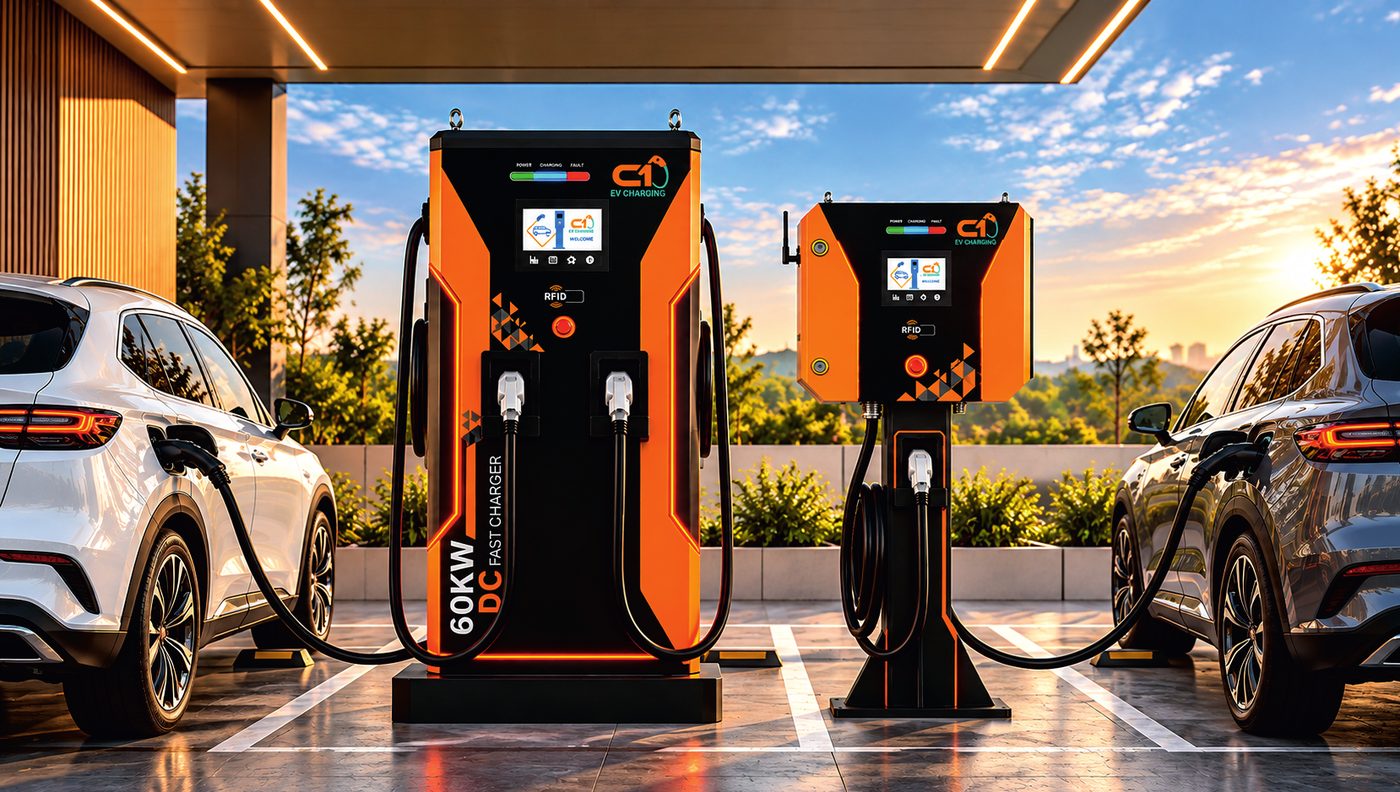
A DC fast charger is what turns an electric car from a city vehicle into one that can travel and work a full day. C1's ultra-fast DC chargers range from 60 kW to 240 kW, and they are built for the places where time matters most: highways, fleet depots and busy public hubs.
AC vs DC charging in simple terms
An AC charger (3.3 kW to 14 kW in C1's range) passes alternating current to the vehicle, and the car's onboard charger converts it to DC for the battery. That conversion limits the speed, which is fine for overnight charging at home or at work.
A DC fast charger does the conversion inside the charger itself and feeds DC power straight to the battery. With no onboard bottleneck, much higher power is possible, which is why a DC charger is the right tool when a vehicle can only stop for a short time.
60, 120 and 240 kW: which one do you need?
Charging time depends on the battery size, its state of charge and the maximum rate the vehicle accepts, so no charger can promise one fixed time for every car. As a practical guide:
| Power | Typical use |
|---|---|
| 60 kW | Fleet depots, commercial parking, urban public charging |
| 120 kW | Highway stops, busy public hubs, taxi and cab fleets |
| 240 kW | High-traffic highway corridors and hubs that serve many vehicles at once |
Because C1's ultra-fast chargers can serve up to 4 EVs at the same time, a single cabinet can handle a small group of vehicles instead of forcing every driver to queue.
Modular design and why it protects your uptime
A modular charger is built from power modules that work together. If one module needs service, the others can keep charging, so the station is not completely down. Modularity also makes the charger future-proof and upgradable: you can plan for more power as your vehicle count grows. C1's DC range is designed with high efficiency, with the 30 kW CCS-2 model rated at 94% power efficiency, which helps lower operating costs.
Key specifications
| Connector | CCS Type-2 |
| Max. output power | 60 / 120 / 240 kW DC |
| Input voltage | 3-Ph 400 V (+/-10%) |
| Output voltage | 150 to 1000 V DC |
| Display | 7" TFT colour touch screen |
| User authentication | RFID / mobile app based |
| Charger-vehicle communication | Power line communication (PLC) |
| Charger interface | LAN / 4G / WiFi |
| Ingress protection | IP54 |
The wide 150 to 1000 V output window lets the charger work with a broad range of EV battery voltages. Full details are on the product page.
Who benefits most
- Highway operators: drivers stop for minutes, not hours, so high power and reliability decide your revenue.
- Fleet operators: cabs, buses and delivery vehicles earn money only when they are on the road, so turnaround time is critical.
- Public hubs and malls: a visible fast charger attracts visitors and increases dwell time.
- Municipal projects: dependable public charging that serves the whole city.
What your site needs
High power needs a strong supply. Before choosing a charger, plan for these points:
- Power availability: a three-phase 400 V connection with enough sanctioned load. A 240 kW charger needs a very different supply from a 60 kW one.
- Transformer and cabling: dedicated transformer capacity, trenching and properly sized cable.
- Earthing and protection: see our guide on why certified EVSE technicians matter.
- Space and traffic flow: room for vehicles to enter, charge and leave without blocking each other.
- Connectivity: LAN, 4G or WiFi so the charger stays online.
The charger is designed for indoor and outdoor installation, with IP54 ingress protection.
Network connectivity and OCPP
A charger that is not connected is just a power outlet. With network connectivity, the owner can see sessions, set tariffs, authenticate users with RFID or a mobile app, and watch for faults remotely. C1 chargers are network-ready and compatible with e-mobility platforms, and our team provides 24/7 remote monitoring and proactive maintenance so that uptime stays high.
Frequently asked questions
What is the difference between a 60 kW, 120 kW and 240 kW DC charger?
The number is the maximum output power. Higher power can deliver more energy per minute, but real charging speed also depends on the vehicle's battery and the maximum rate it accepts.
Can C1's ultra-fast DC charger charge more than one vehicle at a time?
Yes. The 60 to 240 kW range can charge up to 4 EVs at the same time.
Which connector do C1 DC chargers use?
C1's DC fast chargers use the CCS Type-2 connector, with power line communication (PLC) between charger and vehicle.
Can I install a DC fast charger outdoors?
Yes. C1's CCS DC chargers are designed for indoor and outdoor installation and carry IP54 ingress protection.
How do I get a quote for a 60, 120 or 240 kW charger?
Tap Get a Quote and share your site and vehicle details, or call 9278331900. Our team will recommend the right power level.
Planning an EV charging setup?
Share your site and vehicles. Our team will recommend the right chargers and installation plan.